
Industry Field Trips
Steele Canyon High School is excited to offer engaging field trips designed to enhance our Career and Technical Education (CTE) curriculum. These excursions provide students with immersive experiences that extend their learning beyond the classroom. Our trips are thoughtfully planned to ensure that every student gains valuable skills and insights that will benefit them in their future careers.


Interested in Dual Enrollment?
Career Technical Education (CTE)
Empowering students through academic and technical excellence.
The SCHS CTE program prepares students for college, careers, and the world of work through hands-on, industry-relevant education. With some pathways articulated with Grossmont and Cuyamaca Colleges, students can earn college credit while building practical skills and exploring their passions.
.png)
Who we are
The SCHS College and Career Technical Education (CTE) program is designed to provide all students with opportunities for enhanced learning experiences, preparation for future career decisions and a realistic view of the world of work.
Elective CTE Courses provide students with the academic knowledge and skills needed to prepare for post-secondary education. Some of the CTE courses will be articulated with Grossmont and Cuyamaca College, and offer students an opportunity to earn college credit. Students also receive a strong experience and understanding of some aspects of the industry they are considering for a future career.
The competency based applied learning methodology featured in CTE courses contributes to the academic knowledge, problem solving abilities, work attitudes, technical expertise and future employability.

CTE Pathways
Concentrator
TBA
Capstone
Pathway Information
TBA
A two course pathway that introduces students to the art and technology of bringing stories and characters to life through movement. Students explore the principles of animation, storytelling, character design, and visual development while learning industry-standard software such as Adobe Animate, After Effects, and Cinema 4D. Through hands-on projects, they create original animations, storyboards, and short films that showcase both creativity and technical skill. This pathway prepares students for careers in animation, film, game design, and digital media, as well as for advanced study in related visual arts fields.
Concentrator
A one term course open to all grade levels. Must at least be concurrently enrolled in Honors Math II. Students will learn the principles that underlie the science of computing and develop the thinking skills that computer scientists use. Students will work on their own and as part of a team to creatively address real-world issues using the tools and processes of computation. Skills will be gained in making connections between concepts in computing, designing a program to solve a problem or complete a task, applying abstractions in computation and modeling, analyzing computational work, communicating ideas about technology and computation, and working collaboratively to solve problems. Content will cover Digital Information; Introduction App Design; Variables, Conditionals, & Functions; Lists, Loops, & Traversals; Algorithms; Parameters, Return, & Libraries; The Internet; Data; Cybersecurity & Global Impacts; and Physical Computing. This course meets the University of California “d” science requirement and can be taken as a 4th year of science.
Capstone
A one term Honors course open to 10th, 11th and 12th grade students. Computer Programming II introduces students to software engineering and object-oriented programming and design using the Java programming language. This curriculum covers a broad range of topics, including the design of solutions to problems, the use of data structures to organize large sets of data, the development and implementation of algorithms to process data and discover new information, the analysis of potential solutions, and the ethical and social implications of computing systems. This course meets the University of California “d” science requirement and can be taken as a 4th year of science. Prerequisite: AP Computer Science CTE
Pathway Information
A two course pathway where you learn to program in the JavaScript language with turtle programming in Code.org’s App Lab. Using the general principles of algorithms and program design, you’ll create a series of real working apps that you can share with your friends! Explore the internet and its layers as you learn about the challenges of supporting a giant network like the world wide web. No experience required.
Concentrator
Administration of Justice, is the first of a two-course Career and Technical Education (CTE) Administration of Justice pathway.
The course will familiarize students with basic characteristics of the criminal justice system. While concepts of crime, punishment, and justice cross cultural and political boundaries, the emphasis in this class will be on the United States. The class is dual-enrollment with Grossmont College.
Capstone
Advanced Criminal Law is the second of a two-course Career and Technical Education (CTE) Administration of Justice pathway.
The course will introduce students to doctrines of criminal liability in the United States and the classification of crimes. In particular, students will learn how crimes are defined by statutory elements, and how the government proves those elements within the criminal justice system. Students will use the California penal code and criminal law case studies. The class is dual-enrollment with Grossmont College.
Pathway Information
A two course pathway, the Administration of Justice Pathway is designed for students that have an interest in the law, law enforcement, and the criminal justice system. The two classes in the pathway ask students to provide research-based answers to real-world issues, such as the effectiveness of criminal laws, failures within our current system of incarceration, and problems caused by bias of jurors and witnesses during trial. Students will take field trips to a local police station and the downtown courthouse, and they will participate in dynamic activities including mock trials and designing their own prison.
Concentrator
A one term course that will provide entry-level trainingIn the CTE Digital Photography pathway you’ll learn the functions of the digital camera and how to edit photos using professional software such as Adobe Photoshop and Lightroom. Through fun, hands-on projects, you’ll practice shooting portraits, action shots, creative images, and much more! Students will learn professional tools and build a beginner portfolio that can be used for entry level positions in areas such as media, design, marketing, and content creation. No experience needed!
Capstone
TBA
Pathway Information
This is a new course starting in 2026-2027.
Concentrator
TBA
Capstone
TBA
Pathway Information
A two course pathway that introduces students to the creative and technical skills used in the graphic design industry. Through hands-on projects, students learn the principles of design, typography, color theory, and digital illustration while using professional software such as Adobe Photoshop, Illustrator, and InDesign. This pathway encourages creative problem-solving and prepares students to design logos, posters, branding materials, and digital media. By completing the program, students gain a strong foundation for careers in graphic design, marketing, advertising, or further study in visual arts and design fields. (Receives college credit)
Concentrator
A one term course where students will learn news gathering strategies and techniques, mass media criticism and analysis skills, recording video with sound, video editing, sound missing, script writing as well as vocal performance and delivery. Students will prepare and present broadcasts that include school news, features, as well as enterprise and investigative stories. This course meets the University elective “g” requirement.
Capstone
A one term course where students learn the basics of video production including: storyboarding, script writing, videography and editing. Students will break into teams to plan, write, shoot and edit their own short films from a variety of film styles. Student project genre options will include: sketch comedy, drama, musical, documentary, biography, educational and action/adventure. In addition, students will critique famous film scenes for ideas & inspiration to improve their own work. Prerequisite: Media Production Broadcast grade of “C” or better or teacher recommendation. This course meets the University elective “g” requirement.
Pathway Information
A two course pathway where students create audio and video media in a variety of styles for a range of different formats. Students in Media Production use cameras, microphones and editing software to produce news & entertainment content. In this project based course, students gain confidence with their camera work, vocal performance and creative writing.
Filmmaking provides an immersive experience in storytelling through the lens. In this hands-on course, students practice the elements of story, preproduction, performance, videography, editing, sound and effects. In addition, students put those skills to work in creating their own scenes and short films with the option to enter various film competitions throughout the year.
Upon completion of this pathwath, students will have the skills to pursue a career in online media, content creation, visual marketing, television and film.
Concentrator
A one term course open to all students and designed to develop students artistically according to the California State Visual Arts Standards. Students will develop a skill set in both Jewelry Design Metalsmithing and the very latest Jewelry Computer Aided Design (CAD) software and 3D printing processes. Students will design, and then create, jewelry art using both traditional metalsmithing techniques and CAD. Students explore techniques and processes using non-ferrous metals in a safe environment and find solutions to challenging assignments. Students interpret and analyze artwork in both historical and contemporary contexts. Students make connections to how the skills developed in this class can be applied and lead to both art and technical careers. The goal of this course is to seamlessly combine the valuable traditional artistic designing and “hands on” metalsmithing skills, with the newly emerging jewelry design CAD and 3D printing Technology to understand and apply both in creating jewelry. This course meets the University of California Visual & Performing Arts “f” requirement.
Capstone
A one term advanced level course for students who have successfully completed previous levels of Jewelry Metalsmithing, Computer Aided Design (CAD). It is designed with particular emphasis on creation of jewelry and sculptural objects. Metal and other types of permanent material will be used in relation to objects and techniques of the past, present, and future with emphasis on design CAD and 3D printing technology to understand and apply in creating jewelry. Students emulate real world jewelry design and work skills. Advanced level courses have an emphasis on individual proficiency and developing a personal portfolio. Advanced Jewelry Metalsmithing meets the University of California Visual & Performing Arts “f” requirement. The Portfolio class DOES NOT meet the University of California Visual & Performing Arts requirement.
Pathway Information
A two course pathway where students will develop a skill set in both Jewelry Design Metalsmithing and the very latest Jewelry Computer Aided Design (CAD) software and 3D printing processes. Students will design, and then create, jewelry art using both traditional metalsmithing techniques and CAD. Students explore techniques and processes using non-ferrous metals in a safe environment and find solutions to challenging assignments.
Concentrator
The CTE Music Performance/Guitar Introductory course builds foundational skills in musicianship, live performance, and music industry fundamentals. Students develop technical proficiency on guitar while learning music theory, chord charts, scale systems, and ensemble performance techniques.
In this course, students rehearse and perform as part of a guitar ensemble, collaborate with peers, and build confidence through live performance opportunities. Students also explore music technology basics, stage setup, equipment care, and an introduction to how live shows and the music industry function behind the scenes.
This course prepares students for advanced performance work in the Concentrator course and strengthens skills in creativity, collaboration, and professional musicianship.
Capstone
The CTE Music Performance/Guitar Concentrator course is the culminating experience in the two-course Music Performance pathway. Students refine advanced performance skills while applying real-world industry practices used by working musicians.
Concentrator students rehearse and perform in advanced ensembles, create original or arranged works, and take on leadership roles within the program. In addition to performance, students design professional materials such as press kits, stage plots, technical riders, promotional graphics, and digital content.
Emphasis is placed on artistic growth, professionalism, collaboration, and career exploration. By the end of the course, students demonstrate industry-ready skills in performance, music technology, and event production; preparing them for college programs, careers in music, or independent creative work.
Pathway Information
Two course pathway
Ready to shred, strum, and groove? In this CTE Guitar & Music Performance class, you'll learn to play guitar, explore music theory, and develop the skills to perform like a pro! From classic riffs to modern hits, you’ll master chords, scales, and even put on live performances. Whether you're a beginner or already jamming, this class will level up your musical abilities and introduce you to careers in the music industry. Grab a guitar, take the stage, and let’s make some noise!
Concentrator
In this course students will be introduced to the fundamentals of technical theatre and stage production. Students learn how live performances are supported through scenery, lighting, sound, and backstage operations. They build and paint set pieces, explore the basics of stage lighting and sound equipment, and practice safe use of tools commonly used in theatre production. Students are introduced to the design process and how technical elements help tell a story on stage. Throughout the course they collaborate as a production team, develop problem solving skills, and gain hands on experience supporting performances.
Capstone
Pathway Information
In this course students will expand their technical theatre skills through direct involvement with productions by the Steele Canyon Players. Students apply their knowledge of scenery construction, lighting, sound, and backstage operations while supporting an active production during the term. They participate in building and installing sets, programming and operating lights and sound, and assisting with technical design and production planning. Students work as part of the production team and learn how technical elements support the artistic vision of a live performance. The course emphasizes collaboration, responsibility, and real world production experience.
In this two-course CTE Stagecraft pathway, students develop a comprehensive set of technical theatre skills through hands-on learning and creative problem-solving. They gain experience in scenic design and construction, learning how to safely build, paint, and move sets and scenery. Students explore lighting, sound, and projection design, including programming and operating industry-standard hardware and software to enhance storytelling on stage. They also manage props, costumes, and backstage operations while applying principles of organization, teamwork, and time management. Additionally, students learn key aspects of production management, budgeting, and marketing—preparing them for future work in live event production, theatre, and related technical fields.
Concentrator
A one term course that provides instruction in topics related to patient care and the medical field with the aim to provide students with a sample of medical related information and career paths. These topics include; anatomy, cell and tissue structure and response to injury, body systems, nutrition, psychology, first aid and CPR, conditioning and fitness, exercise physiology, therapeutic modalities, therapeutic exercise, pharmacology, kinesiology, and prevention, treatment, taping and rehabilitation of injuries. This is the first of a two course CTE patient care pathway. This course meets the University of California elective “g” requirement.
Capstone
Pathway Information
A one term course that provides instruction in advanced topics related to patient care and the medical field with the aim to provide students with a higher knowledge of medical related information and a more in depth look at medical career paths. Advance anatomy, exercise physiology, therapeutic modalities, therapeutic exercise, massage, and taping principles will be integrated with the prevention, treatment, and rehabilitation of injuries. This course will also include an in depth look at the body systems and their physiology as well as a focused exploration of possible career paths in the field of medicine. The focus of this class will be to prepare the students to continue on the path of pursuing a career in the medical field. Prerequisite: Must have completed Sports Medicine. This course meets the University of California elective “g” requirement. Students can receive 3 units of college credit for ES 255: Care and Prevention of Athletic Injuries by completing the pathway with a B- or better.
A two course pathway that provides instruction in topics related to patient care and the medical field with the aim to provide students with a sample of medical related information and career paths. These topics include; anatomy, cell and tissue structure and response to injury, body systems, nutrition, psychology, first aid and CPR, conditioning and fitness, exercise physiology, therapeutic modalities, therapeutic exercise, pharmacology, kinesiology, and prevention, treatment, taping and rehabilitation of injuries. This is the first of a two course CTE patient care pathway. This course meets the University of California elective “g” requirement. (Receives college credit)
Introductory Course
In this course students will be introduced to the foundations of theatre performance and production. Students explore basic acting skills including voice, movement, improvisation, and character development. They learn stage terminology, basic script work, and how actors collaborate within an ensemble. Students participate in theatre games, scene work, and short performances while developing confidence and communication skills. The course also introduces students to the rehearsal process and the collaborative nature of creating live theatre.
Concentrator
Capstone
In this course students build on their foundational theatre skills while exploring theatre in greater depth. Students continue developing acting techniques while also studying play analysis, storytelling, and character interpretation. The course introduces students to directing concepts, staging, and how to guide actors through rehearsal. Students examine scripts, explore different theatrical styles, and develop a deeper understanding of how performances are shaped from page to stage. Collaboration, creative problem solving, and ensemble work are emphasized throughout the course.
In this course students apply their theatre training through direct participation in productions that are part of the Steele Canyon Players season. Students work through the full production process including auditions, rehearsals, character development, and live performance. They collaborate as an ensemble while refining acting skills, rehearsal techniques, and stage presence. Students gain experience in the discipline and responsibility required to bring a full theatrical production to an audience. The course emphasizes artistic growth, collaboration, and commitment to the production process.
Pathway Information
A three course pathway
At every level/dimension of this theatre coursework, students can expect to broaden their knowledge, and challenge their abilities as actors and producers of theatre, while developing a strong understanding of stagecraft, acting practices, audition/rehearsal techniques, character development, and script writing/analysis. Additionally, theatre history, culture, and design methodologies will be examined and career opportunities will be explored. As a result of this work, students will experience invaluable training in skills necessary for their academic, social, and critical thinking future. Through creating theater, students will grow in their ability to comprehend the world, have empathy, and communicate with others.
Connecting High School to College and Career
What is a CTE pathway?
A CTE pathway is a sequence of two or more CTE courses within a student’s area of career interest. Pathways are designed to connect high school classes to college, industry certifications, and/or a career.
Why should students participate in a CTE pathway?
While in high school, students have the opportunity to acquire free technical skills training in the career field he/she is interested in. Students will learn valuable technical skills and soft skills making them employable regardless of the field of study they actually end up in.
Are any CTE classes in pathways articulated with local community colleges?
Yes! Some CTE courses are articulated with Cuyamaca and Grossmont colleges. At the beginning of each school year, CTE teachers work with CTE transition coordinators from Cuyamaca and Grossmont college to begin or renew their course articulation agreements.
How do CTE courses prepare students for college and career?
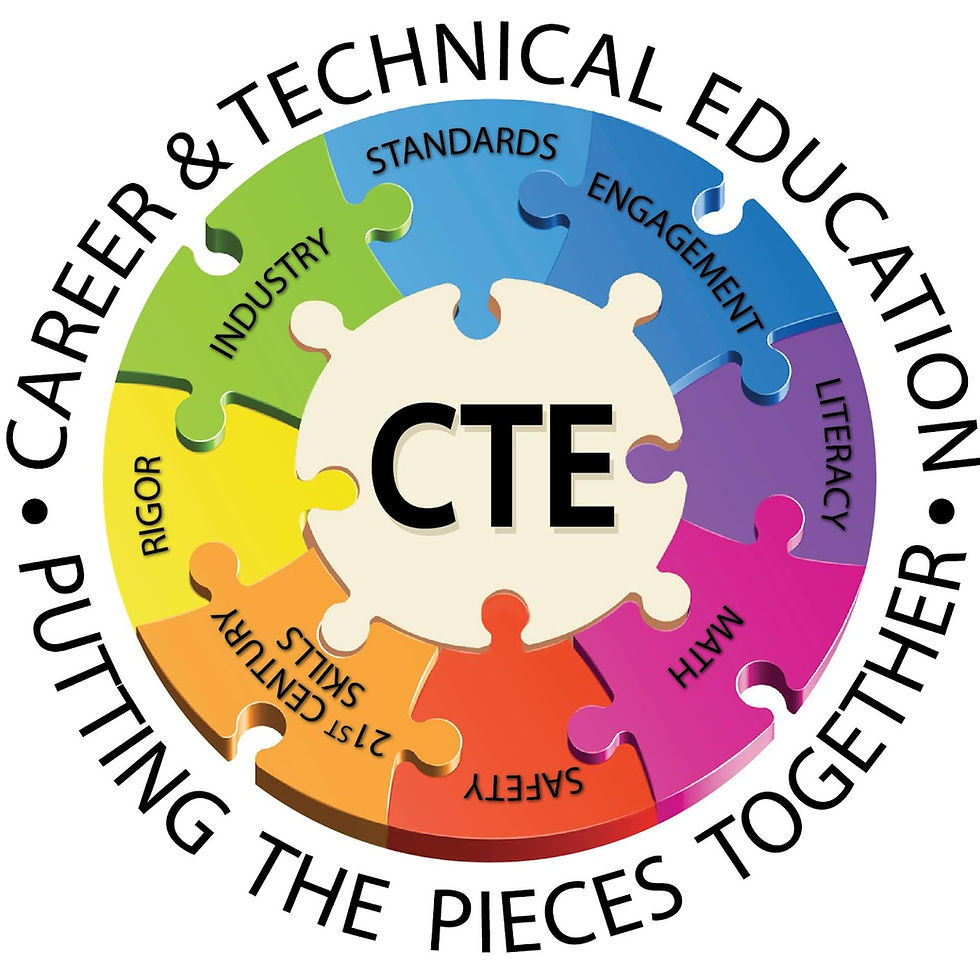
All CTE courses support the Common Core and CTE Model Curriculum Standards (MCS). Learning rigorous academic skills, especially in English Language Arts and Mathematics are an integral part of each CTE course outline and competencies. These skills help our students put English Language Arts and Mathematics to work in a real-world, hands-on environment they can relate to. The CTE MCS are designed to assist school districts in developing high quality curriculum and instruction to prepare students for future careers. The MCS were created with assistance from more than 300 representatives from business, industry, postsecondary and secondary education and reviewed by nearly 1000 members of the general public. These standards are rigorous, evidence-based, relevant and reasonable in scope http://www.cde.ca.gov/ci/ct/sf/mcsbriefpaper.asp
CTE Staff
Jordan Parker
Position / Role
Max Johnson
Position / Role
Drew Carlyle
Position / Role
Morgan James
Position / Role